Is the face
of Islam changing? 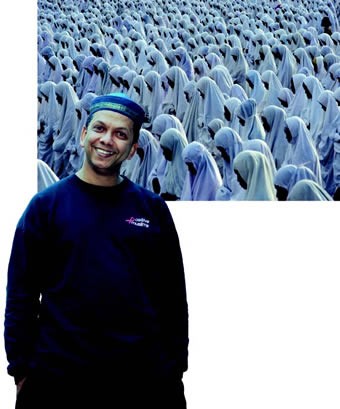 The Editors Interview Farid EsackIn the aftermath of September 11, South African scholar Farid Esack has become one of the most sought-after interpreters of Islamic thought in the United States. A progressive Muslim theologian who cut his teeth in the anti-apartheid struggle, Esack received his theological education in Pakistan. While studying in some of the same Karachi schools that also educated the leaders of the Taliban, he became increasingly disillusioned with both the narrow Islamic ideology and the oppression of Christians he encountered there. The Pakistani Catholics he met in the 1970s and early '80s introduced Esack to the ideas of liberation theology. Currently a visiting scholar at Union Theological Seminary in New York, he is the author of On Being a Muslim and Qur'an Liberation & Pluralism (both Oxford/Oneworld). In
the U.S. media, you seem to have become the go-to-guy for a
progressive voice of Islam. How large a movement is progressive
Islam? What does progressive Islam
offer in the current crisis? Shortly after the bombing [in Afghanistan] happened, as I was teaching a class and
talking about Muhammad's life in Mecca and Medina, it occurred to me
that it is a problem for us Muslims that we have only two
theological paradigms and precedents on which to base our lives, and
that that limitation is in part responsible for the mess that we are
in. The one is the paradigm of a community of oppressed people in
Mecca, and the other is of a Muslim community that is in control in
Medina. What we don't have is a model for coexisting with other
people in equality.
But there is a third way, what I call the "Abyssinian
paradigm," which refers to the time when the Prophet sent a
group of his followers from Mecca to go and live in Abyssinia. They
lived there peacefully for many years, and some of them did not
return, even after Muslims were in power in Mecca. They did not make
any attempts to turn Abyssinia into an Islamic state. They sent good
reports back about the king under whom they were living, and how
happy they were living there.
This is the third paradigm that Muslims today more than ever need
to revive because it is crucial for the sake of human survival and
coexistence. Until recently the notion of coexistence and cultural
tolerance was pretty controversial for mainstream Islamic thinkers,
but I was surprised at a recent Muslim conference to hear more and
more people talking about the need to revive this Abyssinian
paradigm. Mainstream Islam is beginning to listen to what we are
saying.
What kind of responses do you
see within the Muslim community in the aftermath of September 11? Beyond that, there have been many different reactions to
September 11 in the Muslim community. It is true that a significant
part of the community has quite frankly secretly—and in some parts
of the world, even openly—rejoiced in the attacks on the World
Trade Center and the Pentagon. Another part of the Muslim world has
been unequivocal in its condemnation and in sadness about these
events.
Then there are others who, while sad about the loss of innocent
human lives, nevertheless would have had no issue with seeing those
buildings go. For them, the buildings were symbolic of a different
kind of "terrorism" represented by the global economic
system and its effect on the Third World. As a direct result of the
bombing of Afghanistan, that kind of resentment toward the United
States has further increased. Is
that resentment widely shared in the Islamic world? Resentment of the U.S. is widespread across the Third World. On
September 11, people in many black townships in South Africa were
rejoicing, as were some in Latin America. But the news value of this
rejoicing only extended to reactions in the Middle East.
So while it is not a peculiarly Muslim phenomenon, this
resentment does perhaps get aggravated in the Muslim world because
for many Muslims it's a double anger. It's both an anger at the fact
that the United States is controlling relations all over the world
and an anger at the fact that Muslims are not the ones in
control.
The particular Muslim resentment about not being the ones in
control stems from ancient memories of the first Medina, the
so-called "Golden Age of Islam," and the desire to return
to this state of near-mythical perfection. Medina is seen as the
perfect paradise on earth, as a time when Muslims ruled the world
and everything about it is glorified and mythologized.
This mythical period is contrasted with the misery of today. The
current image of the Muslim world is one of ruin and devastation,
petty dictatorships and wars, starvation and begging bowls, and an
endless current of refugees. So when you can't gel your glamorized
version of your past with your current reality, it leads to a pretty
messed-up psyche.
How large a role does the U.S.
alliance with Israel play in driving the resentment of the United
States in the Muslim community? I believe in the right of Israel to exist. We have to accept
reality, because too much water has flowed under the bridge. It's
painful, of course, that even as we're talking, new realities are
being created with the building of additional settlements—more
water is being brought to flow under the bridge—precisely to take
advantage of this kind of generous thinking that I'm expounding.
The U.S. armed Saddam to fight
the Iranians; we armed the predecessors of the Taliban to fight the
Soviets; now we're getting into bed with the Northern Alliance. Is
the U.S. realpolitik approach to foreign policy contributing to our
problems in the Middle East? Now the U.S. government acts out of great anger. There is a kind
of cowboy mentality that has set in. Nobody wants to think, and then
people come and ask me, "OK, so tell us: What do you
think we should be doing now?" That question is very narrowly
focused on what we should do now in response to what has just
happened and whether there is any alternative to bombing.
People don't want to discuss things in long terms; they don't
want to look at the broader picture. It doesn't fit into a sound
bite. If it takes longer than a minute, then we don't have the time.
So now that we are in the
middle of a war, is it too late to come up with constructive solutions? At the end of the day, there has to be an acknowledgment that
there were grievances underneath all of these conflicts and that
there is no way we will ever be able to sleep peacefully unless we
begin to address these grievances.
Is the current crisis an
isolated conflict with Islamic fundamentalists, or is this part of
a broader conflict between the West and the Islamic world? On the other side of the conflict we are dealing with another
religious fundamentalism, one that is not generally recognized as
such. The Buddhist theologian David Loy has described faith in the
free market as a religion, a religion with a transcendent god, a god
that is worshiped and that its adherents have a deep yearning to
embrace and to be at one with—and that god is capital.
It also has a theology in the form of economics, a fundamentalist
ideology that excludes all others. Its cathedrals are the shopping
malls, and there is paradise or the promise of paradise for those
who get on board. It is the fastest growing religion in the world
today.
If you look at the language of your president, his notion of
absolute evil and complete abhorrence, as well as Osama's language
of complete abhorrence, neither recognizes the possibility of any
grace on the other side. Both espouse very hardened kinds of
fundamentalisms.
I don't think that Bush is the problem, but neither is Osama
solely the problem. It's these fundamentalisms and what gives rise
to them that are the crucial issue.
You've had a lot of contact
with Islamic fundamentalists. How do you talk with them? I really believe that fundamentalism is a mindset. I'm currently
teaching at Union Theological Seminary in New York, and there are a
good number of "fundamentalists" here. Fundamentalism can
be economic, or it can be feminist. There are all sorts of
fundamentalisms.
The fundamentalist mindset comes from insecurities and fears, and
if you want to engage fundamentalists, you need to learn how to
address these fears. It is a struggle that needs to be fought at
personal, educational, and political levels.
But how could our political
and cultural tension escalate to such awful terror acts? Difficult as this may be for us to understand, in the twisted
minds of these suicide bombers, they too saw themselves as giving
their lives so that a larger part of humanity may live. For them the
United States is the enemy, Satan incarnate, who is causing chaos
and destruction around the world.
How does the history of the
Christian-Muslim encounter over the centuries continue to play into
current conflicts? What should people know about
the history of Christian-Muslim relations? Of course, history also frequently is manipulated. For example,
Jerusalem has only become as important as it is in today's Muslim
imagination over the past 50 years. And that happened as a result of
political tensions and interests. Today Jerusalem looms far larger
in the Muslim religious imagination than it has ever before.
What can ordinary people do to
help Christian-Muslim relations? It's true that sometimes they can seem like somewhat irrelevant
forums for a polite show-and-tell. You meet with these other nice
people and show them your religion's nice verses about peace and
justice and living in harmony, and then you get a nice pat on your
back from the other people in the interfaith forum: "Good boy,
good boy."
In my book Qur'an Liberation and Pluralism, I took a
different approach, looking not at the "nice verses" but
rather at the difficult texts of the Qur'an.
I was reminded of that the other day when there was a letter in
the New York Times from somebody who was upset about hearing
that an imam had said that the Jews and the Christians will never be
happy with you until you abandon your religion. She was upset with
the imam, but the article she was referring to didn't mention that
the imam's quote was actually from the Qur'an. Those kinds of things
don't usually get dealt with when dialogue is stuck in politeness.
As someone once put it, "Is there life after tea?"
But despite such limitations, by the end of the day, we don't
have an alternative to engaging in conversation.
The village of the world that we live in today is completely
intertwined. You can't unbake the cake of globalization. You can't
separate the sugar from the flour from the water from the vanilla
from the cream. What you do to Muslims in the world today, you do to
Christians; and what you do to straight people, you do to gay
people; what you do to black people, you do to white people; the
essential condition of humanness today is interconnectedness.
How do you teach or promote
this sense of interconnectedness and tolerance? Religious people, of course, have always been at the cutting edge
of this kind of universalization, in part because we've always
believed that our messages were universal. At the same time we need
to acknowledge that that has also had a downside when we have
couched our universal religious messages in terms of superiority.
What's the particular role of
the United States in today's inter-connected world? I sometimes think of the United States as a very large house that
has a huge extended family living in it. The house is headed by the
big brother. Every day he comes home with chocolates and sweets, and
he looks after the family very, very well.
This family never actually leaves the house. So they have no idea
where big brother gets all his goodies from, and they're not very
interested in finding out either. They're only too grateful that
he's sharing them. They have no idea that, with the help of other
bullies in the neighborhood, big brother has been throwing stones
and creating havoc all around the block and in other neighborhoods
as well.
Then one day, somebody throws a huge brick into the house and
hurts several of the family's little sisters and brothers. The
family is both angry and confused because big brother has been
regaling them with stories about how nice he has been to everybody
in the world and how many sweets he has been dishing out to
so-and-so. And now so-and-so has come and thrown this brick at the
house and hurt the little kids.
So everyone is just completely puzzled at why anyone in the world
would do something like that. But big brother quickly says,
"It's just because they're jealous of me. They're not built as
well and not as good-looking as I am."
Perhaps the challenge for the U.S. is to become less great—if
you insist on defining greatness in terms of
"well-having." I think the measure of greatness should
instead be on "well-being." In the meantime it would be
wonderful if the U.S. could exercise its greatness with more
humility.
|

